Tuesday, August 20, 2013

Full of Apple's Juice?

I, like every Apple fan, eagerly await September 10, when (allegedly), the new iPhone--or iPhones--will be released. Each Apple keynote is an opportunity to revel in the future, and for the company to vaguely make me feel bad that each and every bit of my tech isn't brand new. It's the ultimate "I love you, honey, but you're looking fat" moment, brought about three times a year.

But what I'm particularly looking for is how the supposed iPhone 5C will be released. When I got my first iPhone, a 3GS, it was the $100 alternative. Money was a little tight and my wife nonetheless got it for our wedding anniversary. Flash forward to a few years later, and we've become an Apple house: her iPhone 4, MacBook Air, my iPhone 4S, Mac mini and iPad 1, our Apple TV... not to mention our forays into iTunes purchases, iCloud storage, and my excitement over having iWork in the Cloud as a beta.

But what about this 5C? The other (non-Apple) addition to our family is our daughter, who is now two and a half. She's grown up with iDevices, learning how to turn on the iPad's "picture frame" option from the lock screen shortly after turning 1. Now she's a whiz: she can unlock a device, fine the photos app, Netflix, BrainPOP, Elmo... along with occasionally (and frighteningly (for me)) pressing that white folded paper button--the one with clouds in the background (email).

However, she occasionally drops these devices too.

Will the 5C, with it's plastic cover, be attractive to me? Granted, the 5 eschewed the glass excess brought about by the 4/4S... but with a toddler around, I'd like something with a little more bounce.

Conversely, I also want something with more storage space--will Apple box me out by making the 5C have smaller hard drives? Surely it won't be Siri-less--despite the electronic gal being imperfect, she does make texting-while-driving a breeze. Further, I find I need less and less processor oomph in my phone--after all, I can do a ton of computing at home, and the iWork apps are better suited for my aging--yet perfectly adequate--iPad.

I know part of what Apple prides itself on is "the Apple ecosystem." There is a bit of a flip side,
though: after having spent the last 3 or 4 years buying thousands of dollars of Apple tech... it's all made so darned well that replacing any of it is more of a "feel good" or status buy than an actual (perceived) need.

Hence my interest in the iPhone 5C: when I eventually feel the need to replace my 4S, does it need to be with the best of the best? Do I need a sapphire fingerprint sensor and an improved processor... or just
an iPhone that's a bit better for the one I have, to cover needs I already have (email, text, web, camera, music, podcasts)?

I'll know more on September 10.
Monday, August 19, 2013

And A Star To Steer Her By

Please, no poop. I've got 3 breasts.
In considering the notion of geek tech, I suppose that there are a few tempting choices--but tempting in ways that will ultimately be a bit of a let down. Heck, a good chunk of them come from Back to the Future, Part II: the self-fitting, self drying jacket ("your jacket is now dry!  Eeeeeee!"); the hoverboards (I'll take the Mad Dog variety, thanks); or even the 2015 version of the Kinect (which, of course, they had; afterall, the young Frodo-ish boy decried the Wild Gunman game as some lesser thing which required "you to use your hands).  I also considered Star Trek's holodeck, but let's face it: all technology ends up being used for porn at some point, so the limitless possibilities of the machine would end up simply being various types of alien poop being shat on three breasted cat women. 

This is an AWFUL drawing.
Yet all of these technologies are for leisure--for sitting around and "doing as little as possible all day," to quote Lee Adama of BSG fame.  The sentiment that he shares in the series finale is perfect: "I want to explore!" Thus too do I.  And thus my piece of geek tech would not be some small toy that would simply make life more fun, that would help me wallow away the day.  No, I would want myself the ultimate in exploration: the Trimaxian Drone Ship from the planet Phaelon... also known as Max from the film Flight of the Navigator.

Now first, a few caveats.  This film was exceedingly profound when I first saw it on VHS around the age of 7.  Not only does the character of David have some true life roots (dad is gone, which tends to be rare for a family film), but the central problem is fundamentally terrifying to a child: having taken a small fall down a meager hill, David hops right back up and goes home... to find that everyone he loved is gone, has moved out, and moved on.. because 8 years have gone by.

1986 3D rendering into an environment. Amazing.
That would be bone-chillingly shocking if it happened to anyone in real life, but to see it suggested in a "kid flick" brought it into stark contrast with happier stuff.  As the plot goes on, David discovers a small, silver, sentient spacecraft is not only looking out for him, but is also the source of the problem: a four hour hop, skip, and a jump at near-light speed back to Phaelon has resulted in those missing eight years.  (Look it up, Einstein.)

Now, aside from all this drama, what a way to explore!  The ship is the ultimate in conveyance: fast, adaptive, humorous.  (An adult rewatch makes it painfully clear that Paul Rubens is the voice of Max, particularly once Max becomes "silly" and sounds exactly like Pee Wee Herman.)  The film has its limitations: the third act is slowly mired in kid frivolity despite the first two acts being and feeling perfectly serious for an 7- or 8-year-old.  Yet it presents such a feeling of wonder and exploration: a ship to call your own, and a star to steer her by.

As a side note, Flight of the Navigator had liquid metal morphing effects in 1986.  Astonishingly amazing morphing effects in 1986--effects so good that many look near flawless and most require only the smallest grain of salt.

The plot, for those who haven't seen it, turns out alright: after exciting chases and a brief capture by big, bad NASA, David makes his way back to the ship who returns him to 1978.  Fireworks explode, and Max the ship goes zooming by, declaring, "See you later, Navigator!"

See you later?  Pish posh: for those who haven't seen it, see it soon.  Heck, see it now: apparently Disney doesn't care enough to pull rank with its copyright, so you can watch it on YouTube, right now... Navigator!

Monday, August 12, 2013

Dust Yourself Off and Try Again (Try Again)

Some stars burn brightly; others, are stolen from us for no reason at all.  This is particularly true for my subject tonight: a presence of the screen, a chanteuse whose breakout film was inspired by no less than Shakespeare; an angel who played a near-devil in her last film; and someone so talented that she ascended to that rarest of rarefied heights in entertainment, the mononym
Without a dull beat, step to, step to, baby girl, uh.

I write, of course, of Aaliyah.

In her first film, Romeo Must Die, she plays... well, she apparently plays a sort of urban Juliet to Jet Li's Romeo.  I say "apparently" because I never saw the film, though I did once see about half of the video, which featured Jet Lit jumping around in slow motion doing karate chops.  I also know that the hit single from that song, "Try Again," was quite a hit that year (whatever year the movie came out).  You see, I was working for a landscaper who hated most minorities (Jews and Mexicans were at the top of his list), but who loved listening to the "blazin' hip-hop and R&B" on New York's HOT 97! Readers of this blog may recall a Hot 97 reference in 30 Rock thusly: ""shooting people at the Source Awards is a tradition, like shooting people outside Hot 97;" indeed, a list of controversies involving the radio station, including an average of biannual shootings, can be found here.  But I digress.  My landscaping boss listened to Hot 97 endlessly in the truck, leading me to conclude that Aaliyah was such a powerful singer that she only needed to sing one line and they'd loop it together into 3 minutes of a song.  That's talent.

It is with Aaliyah's final film (her second one, too) that real potential for a forked road occurs.  Staring as the title character in Queen of the Damned, the author of the novel of the same name suggested that the filmmakers had mutilated her work and Roger Ebert said the film was "goofy." I wish I could disagree--or agree for that matter, but I haven't seen this film either.

The point, though, is that it was directed by Michael Rymer.  Now, dear readers, aren't you glad to have stuck with me?  With the death of Aaliyah and the film eking out $10 million dollars beyond the $35 million budget (doubtlessly a bomb after marketing), Rymer found himself in need of work... just in time for Ron Moore to snatch him up to direct the Battlestar Galactica miniseries.  Rymer would go on to direct numerous other episodes, including most season openers and finales, as well as the series finale.

Imagine then, if you will, Aaliyah having not died in August 2001 in a plane crash caused by too many posse members on too small a plane.  Imagine Michael Rymer still looking for work, despite the modest box office of Queen of the Damned.  Could we have seen BSG's female roles effected by Aaliyah?  A young, black, female president of the colonies?  A dark skinned, cigar chompin' Starbuck?

Or perhaps the effervescent beauty of this ill-fated wonder would have one her the role of Six.  Would Balter have sold out humanity because of the tall, proud, brown-haired Cylon played by Aaliyah?

Alas, we'll never know; we can only hope... and weep.

Monday, August 5, 2013

Odyssey/Voyage

Ask any knuckledragger and they'll tell you that "odyssey" is just another word for a long trip.  They're knuckledraggers for a reason, after all. We, the well-read, know better.  It's not just any long journey: it's THE journey of literature, taking a decade through mire, tribulation, temptation, age, battle, and exhaustion.  The contrast of this is a voyage, a word spinning up connotations of journey, excitement, a bright sun and salt air.

There is, of course, a long, drawn out, LDS-infused nonsense-wander which is the the great overrated film in all of celluloid.  It's well titled: 2001: A Space Odyssey.  In it, Stanley Kubrick puts form over function, style over substance, and special effects over that which could be emotionally palatable.  Yes, it's iconic--the zero gravity; the glimpse into technology; the openings of pod bay doors, Hal. But it's just so damned... boring.  Now you might think I haven't given the film a fair shake.  There are great films that I've tried to watch a number of times, but keep coming up with the same reaction (stick a bomb in the trunk of my feelings for Touch of Evil too (Charlton Heston, a Mexican.  Indeed!)).  Yet its 2001 which stands atop the critical pile in so many ways.  I mean, #15 of the AFI list?  Better than Sunset Blvd? It's a Wonderful Life?! China-fucking-town?!?  High Noon? Annie Hall?  The list goes on and on--literally, since there are 85 more films that are found beneath it on the AFI list.  Even with some quibbling about the placement of others, it's a list of better films than the drivel that is 2001. Go get high with Timothy Leary, man, and drop your LSD.  It's the only way to enjoy the endless Odyssey.

Now as for a voyage, ah, there's but one film that fits that definition.  Its journey is an odd one: it was, in its gestation, derided as a sinking folly; in its birth, it garnered a review from Janet Maslin in the New York times that proclaimed that it was the first film in years to "honestly invite comparison" to the great films of the 1930s and 1940s.  It was, at its most mature in Oscar season, an unsurpassed nominee with 14 nominations as well as an unsurpassed Oscar winner, with 11 wins, including Best Picture, Director, Editing, and so forth.  It is, of course, the greatest color film ever made: Titanic.  Since, however, that fateful Oscar night on March 23, 1998, this cinematic masterpiece has lost a bit of bloom from its rose.  I propose that the reason is its own popularity, like many blockbusters before it, Titanic's reputation has suffered from "the wrong sort" of people who went to go see it--wrong sort as defined by shallow Hollywood types and faux film fans.  "The 14 year old girl," they say while smelling meat at a restaurant (for Hollywood types do not eat meat, lest they pass out of emaciation), "that isn't who decides films are great."  They pause, sipping their Organically Certified Water, and say wisely, "I'd rather make a film where 20 people have come in from the worst January rain and see the theater as an escape."  They pat themselves on the back for being so original... having forgotten that they've seen Tootsie.

The real magic of Titanic is the magic of all great cinema--indeed, all great art: its universality.  In its long, long box office run into the spring of 1998, a news article made its way around the internet about how the film was as big a hit in China as it was the United States.  A semi-authoritative response was that China saw in the film the fall of a decadent high class, killed by its own folly, whereas Americans saw determination triumphing against the odds of class.  A Chinese viewer saw themselves on the ship, and so did an American.

Indeed, cannot we still see ourselves in Titanic even now--especially now, especially post-2008; that year brought us an unmistakable (economic) calamity brought on by the richest of the rich, and it also brought us a determined president triumphing against a hierarchical structure, parts of which have been sewn into the very fabric of this nation.

This April, Titanic will be re-released, noting the 100th anniversary of its fateful launch.  Expectations are that the film, digitally restored and enhanced, will once again soar to its box office heights.  In related news, no one will be re-releasing 2001: A Space Odyssey anytime sure, for it was the true disaster.

Monday, July 29, 2013

Kane, Alone.

Many films come and go, and many have, as of late, made their way to HD and Blu-Ray.  Yet one film stands above them all--and not just because I say so.  Most cinephines agree (and I would go so far as to say that contrarians are as shoeless rubes standing before the statue of David saying, "He's got his biz-ness out!").

Citizen Kane.  The greatest film ever made.

Its remastering and ascension to the highest home cinema quality is befitting indeed for its 70th anniversary, along with the requisite bonus inclusions of PBS' The Battle Over Citizen Kane and the minor masterpiece of historical fiction, RKO 281.  To watch Kane (along with those bonus films, and the two commentary tracks by Peter Bogdanovich and Roger Ebert) is to know all of cinema.  It is the zenith that all afterwards have tried to climb.

How then does it fit into the question of the week--an actor's body of work?  It is simple: only one actor could convincingly play a character from 24 to 80, all while being 24.  Naturally, I speak of Orson Welles, whose all other films combined do not add up to his acting, directing, producing, writing, and overall micromanagement of this film.  In short, some actors require 10 films for greatness (Daniel Day-Lewis comes to mind as having a nearly flawless resume); yet Welles achieves--if not surpasses that greatness on the strength of Kane alone.  His other acting endeavors merely add to the greatness with varying degrees of success. 

Great art appears static (take note, Mr. Lucas), yet grows with the viewer.  This has been my experience with Citizen Kane, and cause to watch it yearly, as it reveals new things in myself.  Indeed, I wonder what the HD viewing will reveal.  To be clear, there are no changes to this latest release in the film (aside from some readjustments returning the film to its intended clarity--in Berstein's office, for example, the rain has returned!)  Rather, I wonder if seeing the film with extra sharpness will yield any further reflections. Yet it really isn't about the picture; it's the story.

Ultimately Kane is an haute couture funhouse mirror: the mangled, charismatic, enigmatic, loveless, lovelorn Charles Foster Kane is us--his life is all that we aspire to be... at times, anyway.  His fate, his regrets are what is reflected back in that mirror, leaving us to question if it is us, or will be us, at all.

And thus, in considering a body of work, it is as it was in the film.  It is as it should be: Kane, alone.

Monday, July 22, 2013

LOST In the Long Form

A few years ago, a pal helped me out; I was in a bind and needed someone to read an episode summary for my podcast Looking Back At Lost, and he helped me out.  He didn't watch Lost, and as I sent off the text of the summary, I wondered what it must be like to suddenly read about flashbacks and the hatch and tailies and Mr. Eko and computers and buttons and timers with 108 minutes.  As can hear (either here or here), he did a great job.  (Sure, at one moment of frustration with all the plot particulars, he cursed and denounced the show... but hey.)

However, as I prepared next week's podcast for "Everyone Hates Hugo," I was struck by how serialized television is absolutely remarkable.  Had JPR, or any other Lost newbie watched it, the episode would have been coherent enough.  (Indeed, I was irked that the script included plain-jane exposition moments like "So that hatch has a button that needs pushing every 108 minutes?" Such dialogue is there to be kind to new viewers.)

It's the ending that would go over the head of any new viewer--perhaps the best ending of any Lost episode, save the finale.  It's the ending that speaks to a pure, elemental truth while holding up a mirror to ugly corners of the audience's mind.

Lost had 121 episodes, but into the very first one, about 20 minutes in, we are introduced to the character of Rose.  On the plane, she's a mildly nervous flyer, concerned about her husband who has gone to use the bathroom towards the tail.  After the crash, she is inward, serene, and calm.  She says, in the course of the two hour first episode, that she isn't mourning the loss of her husband because he isn't dead.  She is told that she is being unrealistic, that she is in shock.  Now, even if you haven't watched a minute of Lost, you can probably guess the obvious authorial twist: her husband, Bernard, indeed is not dead.

But in the magnificence of the long form of television, we could only predict that, and only while juggling more prominent story elements, both mysterious and up-front.  This long form of television is something that, I fear, gets missed out on when one suddenly has an entire show available to them, be it on DVD, Blu-Ray, or online.  With any dramatic presentation, time must go on in between the episodes.  It's something that the British, with their under-funded television system, miss out on.  Oh, they're so impressed with six consectutive weeks of 30 minute episodes of The Office! That's a blink of an eye, and why the American version was able to slowly, savoringly brew the bond between Pam and Jim.

The effect is doubled, almost literally, with an American network drama like Lost, with 20+ episodes per season (for its first three seasons, anyway).  To have Rose stubbornly declare that her husband isn't dead in September is character shading; for her to repeat it again in the winter of our viewing is keeping up with a recurring "guest" character.  To then return to it a full year after she first looked back on the plane, hoping her husband would return to his seat soon is masterful.

And so that masterful moment, incubated for a year in original-viewing time, or at the very least matured across 25 or so episodes, was brought to fruition.  Some of our main castatways had been on a raft, and ultimately washed ashore on another part of the island, found by mysterious folks. For an episode or two the show teased us, but we were told that those folks were from the tail section.  At that point, naturally, it was only a matter of time before Bernard, Rose's husband, stepped to the forefront.

Yet the show went one step further: not only speaking to the bonds of love, but shaming the audience in the process.  The small contingent of those on the raft, with some of the tail section folks, go back to the meager home base of the latter.

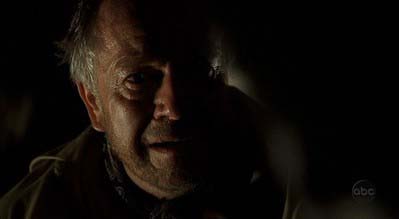
A white man approaches our castaways.  He asks, "Back where you guys, uh, where you came from -- is there a woman named Rose there?"

The hushed response from one of our heroes: "Black chick in her 50's?"

The white man asks, his voice hushed, "Is she okay?" He's told that she is alive and well.  He thanks them, adding, "I'm--I'm Bernard."

To have seen this love from afar develop over a year's worth of episodes is one of the great feats of television; for us to realize, with our meager views, that we always imagined Rose's husband to be a black man shames us and reminds us about the basic, human messages that can be contained by the long form of television.


Monday, July 15, 2013

What's That Smell?

I would propose that there is little honor in getting your ass kicked.  Sure, there are some great fighters out there (Ali, Lion-O, The Rock), but I'm sure Sun Tzu has some sort of Art of War quote about either manning up and having an equal-to-better chance against your opponent, or changing the parameters in order to have an equal-to-better chance against your opponent... or just giving up.  Therefore, I propose that if I'm getting my ass kicked, there is only really one honorable person to do it to me.

Myself.

And I don't mean that in some sort of nambsy-pambsy metaphor, as in "Oh, I wasn't as emotionally ravaged in life as Ana Lucia so when I had to fistfight her I didn't give it my all, therefore I beat myself." I mean getting an ass kicking myself by myself in the only way worth doing it.  Dissociative personality disorder expressing itself in a parking lot.  Sound familiar?  It's from the cinematic anthem to mediocrity and consumerism of my generation.

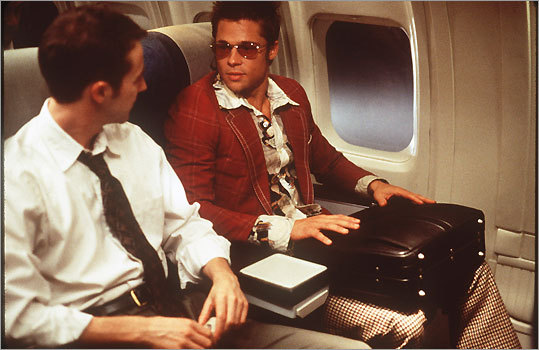
Fight Club.  Fucking Fight Club.

I am Jack's sense of self-loathing.  Oh, and Jack is you.
If I'm going to suffer the indignity of an ass kicking, why not go all out?  Why not just go stark raving mad--have a complete break from reality, start living in an abandoned house, and fuck up the world?  Tyler Durden is an expression of rage against everything: society, belongings, how we relate with others, and how we feel about ourselves.  He represents a fresh, clean start.  No stretch, of course, that he sells soap.

Yet even in that, there's a bit of self-loathing appropriate for the notion of me kicking my ass.  Tyler "dies," and that genie is put back into the bottle.  Indeed, as he passes on, or disappears, or recedes as the Narrator's mind heals (hey, newsflash: the Narrator isn't named, because he's the audience), Tyler almost notices his own corrupt self for the first time.  "What's that smell?" he asks, fading away.

So maybe there is no honor in it.  Or maybe the honor is that once  Tyler Durden kicks your ass, it's only a matter of time before you kick his ass back.

The irony being that you're only beating yourself up.